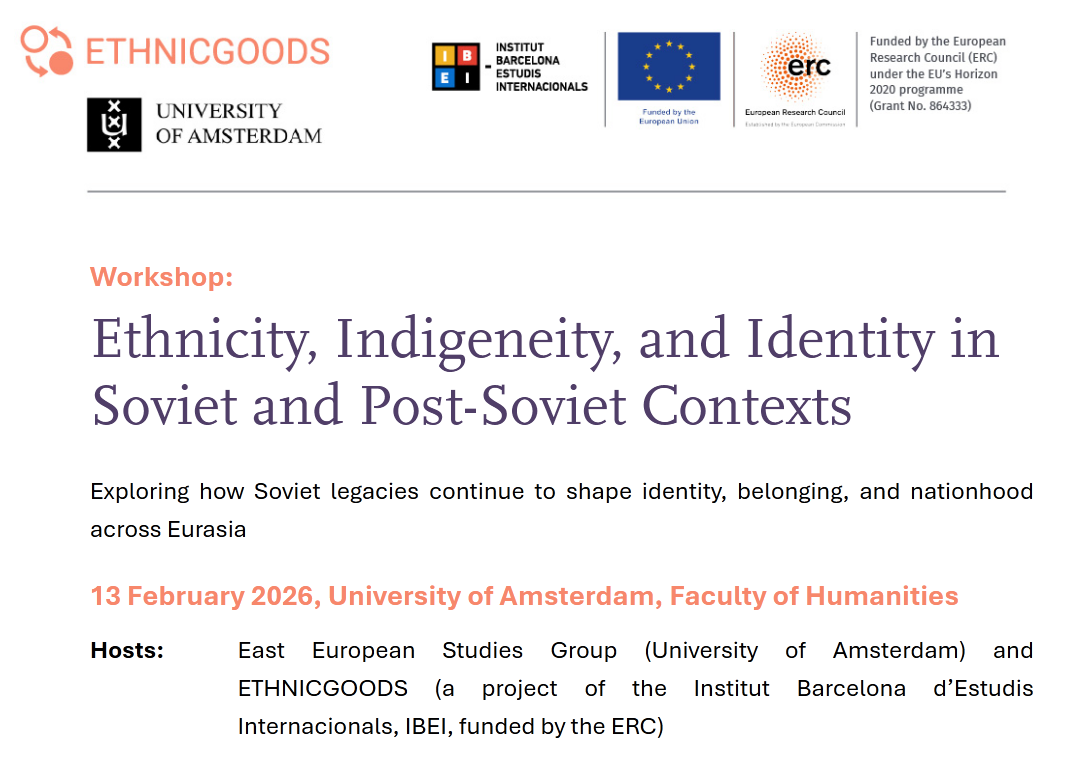

Workshop: Ethnicity, Indigeneity, and Identity in Soviet and Post-Soviet Contexts
Exploring how Soviet legacies continue to shape identity, belonging, and nationhood across Eurasia
-
Date: 13 February 2026
-
Location: University of Amsterdam, Faculty of Humanities
-
Hosts: East European Studies Group (University of Amsterdam) and ETHNICGOODS (a project of the Institut Barcelona d’Estudis Internacionals, IBEI, funded by the ERC)
About the Workshop
The Soviet Union profoundly influenced how ethnicity, indigeneity, and nationality were categorized, governed, and lived. Through nationalities policy, census practices, and institutional frameworks, the Soviet state not only classified its populations but also embedded these identities deeply into social and political life. Yet these categories were never fixed; they were constantly contested, negotiated, and reimagined.
Today, across the post-Soviet space, their legacies continue to evolve in new and complex ways:
-
Central Asia: Soviet-era ideas about nationality and indigeneity intersect with debates on language, Islam, and state-building.
-
The Baltic States: Questions of citizenship and belonging emerge amid European integration and minority politics, reinterpreting the Soviet legacy.
-
Russia: Among ethnic minorities, Soviet classifications still shape autonomy and recognition even as Moscow’s centralizing policies reshape these dynamics.
-
Ukraine: Identity politics are being redefined in light of war, memory, and coloniality.
This interdisciplinary workshop brings together scholars examining how Soviet and post-Soviet identities are contested, renegotiated, and transformed across time and space.
Schedule
09.00 – 9.15: Welcome
9.15 – 10.30: Keynote
-
Perestroika Revisited: Why Was There So Much Ethnic Mobilization in the Soviet Union During and After Perestroika – and So Little Violence?
-
Pål Kolstø, University of Oslo
10.30 – 10.45: Coffee break
10.45 – 12.30: Panel 1 Chair: Andrei Tarasov, Institut Barcelona d’Estudis Internacionals (IBEI)
-
Collective Identity in Transition: A Case Study of Estonian Subcultural Identity from the Soviet to the post-Soviet
-
Isabel Ekua-Thompson, University of Amsterdam
-
-
Who’s Welcome? Security, Soviet Memories, and the Estonian Refugee Dilemma
-
Hakob Matevosyan, Centre for East European and International Studies (ZOIS)
-
-
Ethno-religious Nationalism and Queer Invisibility in Lithuania
-
Rasa Kamarauskaite, University of Amsterdam
-
12.30 – 13.30: Lunch
13.30 – 15.15: Panel 2 Chair: Gulnaz Sibgatullina, University of Amsterdam
-
Colonial Framework in Times of Crisis: Digital Sense-Making in Ukraine after 2022
-
Mila Rossokhatska, University of Amsterdam
-
-
Ukrainian State Media Platforms and National Identity
-
Natalia Vdovichenko, Tilburg University
-
-
From Soviet History to National Narratives: A Computational Study of Armenian and Azerbaijani Textbooks
-
Emre Amasyali, Institut Barcelona d’Estudis Internacionals (IBEI)
-
-
Transnational Belonging and Susceptibility to Disinformation among Russian-Speaking Communities
-
Sabina Imatova, Vrije Universiteit Brussel (VUB)
-
15.15 – 15.30: Coffee break
15.30 – 17.00: Panel 3 Chair: Emre Amasyali, Institut Barcelona d’Estudis Internacionals (IBEI)
-
Language Policy in Public Education in the Soviet and post-Soviet Context
-
Andrei Tarasov, Institut Barcelona d’Estudis Internacionals (IBEI)
-
-
Categories of Nationality and Ethnicity through the Lens of Late Soviet Developmentalism
-
Davlatbegim Mamadshoeva, University of Amsterdam
-
-
Azatlıq Radiosi and the ‘Other’ Tatar Nation: The Cultural and Historiographical Discourse of the Tatar-Bashkir Service of Radio Liberty/Radio Free Europe during the Cold War Era
-
Mansur Gazimzianov, University of Amsterdam
-
-
Nevada-Semipalatinsk Anti-nuclear Movement: Placing the Soviet Union into the Framework of Global Colonialism
-
Kamila Smagulova, Leiden University
-
17.00 – 18.00: Closing notes
18.15 – 21.00: Dinner
Funding & Organization Organized by the ETHNICGOODS Project (IBEI) and the East European Studies Group, University of Amsterdam. This project has received funding from the European Research Council (ERC) under the European Union’s Horizon 2020 research and innovation programme (grant agreement No 864333).
 Amsterdam, Netherlands |
  13 Feb 2026
Please see the poster with full information here.
Call for Participation: International Workshop
Ethnicity, Indigeneity, and Identity in Soviet and Post-Soviet Contexts
Exploring how Soviet legacies continue to shape identity, belonging, and nationhood across Eurasia
Amsterdam, The Netherlands
13 February 2026
Venue: University of Amsterdam
Hosts: East European Studies Group (University of Amsterdam) and ETHNICGOODS (a project of the Institut Barcelona d’Estudis Internacionals, IBEI, funded by the ERC)
About the Workshop
The Soviet Union profoundly influenced how ethnicity, indigeneity, and nationality were categorized, governed, and lived. Through nationalities policy, census practices, and institutional frameworks, the Soviet state not only classified its populations but also embedded these identities deeply into social and political life.
Yet these categories were never fixed; they were constantly contested, negotiated, and reimagined. Today, across the post-Soviet space, their legacies continue to evolve in new and complex ways:
- In Central Asia, Soviet-era ideas about nationality and indigeneity intersect with debates on language, Islam, and state-building.
- In the Baltic states, questions of citizenship and belonging emerge amid European integration and minority politics, reinterpreting the Soviet legacy.
- Among Russia’s ethnic minorities, Soviet classifications still shape autonomy and recognition even as Moscow’s centralizing policies reshape these dynamics.
- In Ukraine, identity politics are being redefined in light of war, memory, and coloniality.
This interdisciplinary workshop brings together scholars examining how Soviet and post-Soviet identities are contested, renegotiated, and transformed across time and space.
Key Themes
We invite contributions that engage with topics such as:
- Soviet nationalities policy and its afterlives
- Institutionalization of ethnicity and identity politics
- The politics of indigeneity before and after 1991
- Memory and narrative as sites of contestation
- Intersections of ethnicity with religion, class, gender, or migration
- Comparative and global perspectives on nationalism and decolonization
Format
This one-day workshop will emphasize discussion and collaboration rather than formal presentation.
Participants will:
- Submit a short draft paper in advance
- Present a 10–15 minute summary of their work
- Engage in structured feedback sessions with peers and a discussant
Panels will include 3–4 participants, fostering in-depth conversation around shared themes.
Who Should Apply
We welcome early-career scholars, PhD researchers, and established academics working on questions of ethnicity, nationhood, and identity in the Soviet and post-Soviet contexts.
Interdisciplinary approaches from history, political science, anthropology, sociology, and related fields are particularly encouraged.
How to Apply
Please send the following to atarasov@ibei.org by 15 December 2025:
- Abstract (200–300 words)
- Short bio (max. 150 words)
Accepted participants will be asked to submit their paper drafts by 1 February 2026.
Practical Details
- No registration fee
- Lunch, coffee breaks, and group dinner provided
- Participants are kindly asked to cover their own travel and accommodation costs
Contact: Andrei Tarasov – atarasov@ibei.org
Organized by the ETHNICGOODS Project (IBEI) and the East European Studies Group, University of Amsterdam. This project has received funding from the European Research Council (ERC) under the European Union’s Horizon 2020 research and innovation programme (grant agreement No 864333).